There’s a place in the heart of downtown Fort Worth, Texas, where the landscape has been given purpose, beauty and nature reign, and water conservation and sustainability have come to the forefront.
The turnaround at Tarrant Regional Water District is an example of how incredible changes can make a difference in water, environment and urban development.
TRWD’s main campus, overlooking the Trinity River, was built in phases over the years. Like many urban spaces developed over time, the terrain surrounding headquarters incorporated natural hills, pockets and dips that resulted in gritty puddles, waterlogging and a soggy landscape after storms. At one point in time, a stormwater detention basin had been developed by TRWD’s Henderson building, the lowest spot on campus, to temporarily store stormwater runoff after heavy rains. The area followed the city’s standard design to prevent flooding and erosion before slowly releasing the water through the storm drains and out to the river.
As the campus grew and construction projects for different phases were developed, however, building plans and permits stacked up. The campus outgrew the capabilities of the detention basin as it was originally designed, and it had become a waterlogged eyesore. Maintenance was a challenge, with lawnmowers sticking in the swampy grass, leaving rows of bumpy ridges as they rolled through. Other than mosquitos, not many creatures chose to call this place “home.” The space was unsightly and no longer in city compliance.
What happened next transformed the basin into one of the most attractive features on campus – plus a money saver.
Water taking shape
An exciting, nature-based plan started taking shape as the Watershed Program, a group within the TRWD Environmental Services division, began collaborations with Texas A&M AgriLife and the City of Fort Worth. AgriLife had experience in the successful design of other detention-based solutions, especially in the Texas coastal regions where hurricanes and extreme weather conditions can present similar water runoff challenges. TRWD’s basin was redesigned as an efficient urban stormwater wetland, the first of its kind in North Texas.
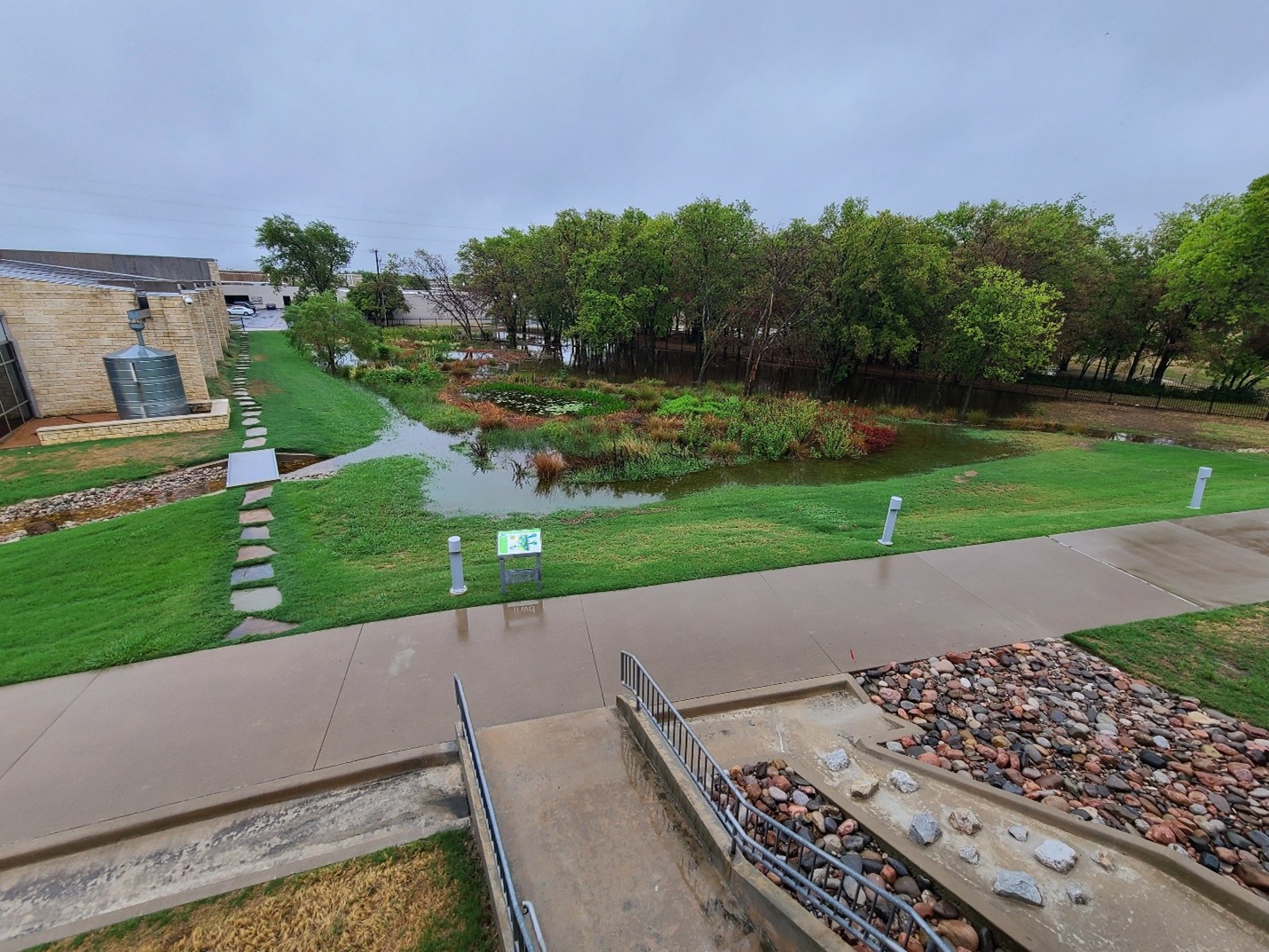
TRWD’s Henderson Wetlands today is a place where dragonflies, frogs, toads, ducks and even crawfish can be found.
The wetland’s reconfigured micro-pools blend peacefully into an even larger natural Rainscapes solution that spans seven acres across the TRWD campus, featuring a variety of native and adapted plants, trees, meandering rock channels, and a raingarden that collects stormwater, slowly infiltrating back into the soil. The raingarden’s function is to replenish shallow groundwater storage for later use by nearby plants in dryer, hotter months.
There are permeable surfaces of mulch and other porous materials, and seven types of water-efficient turf grass.
As water moves from one feature to the next, it is naturally cleaned, filtering its way to storm drains and eventually the Trinity River. Flooding is slowed, and it adds a beautiful aesthetic to the land. The jewel in the crown, which is the last part of the stormwater’s cleansing journey, is the wetland.
Both visitors and those who spend time on the campus each day find that the overall TRWD Rainscapes is the perfect place to walk, unwind and breathe in the sights, sounds and feel of nature.
Benefits
“There is so much that nature does for us,” says Michelle Wood-Ramirez, Urban Watershed Programs Supervisor. “When urban environments are transformed like this, the air quality improves, wildlife and people are better able to engage, and even the temperature cools down. There’s a feeling of tranquility.”
“There are so many benefits we reap in addition to cleaner water when we incorporate Green Stormwater Infrastructure (GSI) into our built environments.”
There are numerous mental health benefits too.
“Here on campus, people love to look out their windows and see ducks and other wildlife,” she says. “It’s so serene.”
TRWD’s space is open to the public, so it’s not surprising to see groups out walking on different days of the week.
“The overall TRWD Rainscapes project has also become a model for homeowners, developers and businesses seeking to conserve water, slow storm drainage and make use of their land in ecological, sustainable ways,” Wood-Ramirez says.
And because cities like Fort Worth reward responsible water resource management, the creation of the Henderson Wetlands, Wood-Ramirez says, has helped TRWD reduce its municipal stormwater utility fees by approximately $10,000 over the last several years.
Wood-Ramirez lends expertise to cities who want to start their own projects or address flooding and erosion issues in their areas. She is also active with schools, universities and local companies – from shopping centers, apartment complexes, businesses and others – to show how nature-based solutions to urban flooding and development can benefit their bottom line as well.
Education and discovery
Collaborative conservation projects like this benefit many through education, research and inspiration.
Through a research project, Texas Parks and Wildlife has set up “game cams” to monitor different species in the wetland. So far, they’ve recorded skunks, possums, coyotes, armadillos and raccoons, a fox, turkeys, different types of frogs and birds, and species of duck not seen before on campus.
Campus visitors can be part of a larger, worldwide nature experiment and contribute to science through the iNaturalist program. This mobile app allows users to photograph and record their observations, share with fellow naturalists and discuss their findings. There is a version for adults and the Seek by iNaturalist easily downloadable app for children.
“Interesting things have been discovered by people wanting to learn more about a bug, plant or animal they’ve seen,” Wood-Ramirez says.
TRWD is involved in a lot more as well, offering educational resources for adults and partnering with area schools on youth experiences and stewardship programs.
TRWD sponsors Save Tarrant Water’s Recognized Green Professional Program for landscapers, master gardeners and those working in jobs that benefit the environment.
Monthly TRWD Rainscapes tours are offered for the community, and special tours are available for visiting out-of-town groups.
“It’s rewarding that Fort Worth now recommends our campus as an example for other businesses. By turning a negative into a positive using ecology and sustainable, nature-based solutions, the land has become healthy, thriving and resourceful,” Wood-Ramirez says. “It’s a place to see.”
For businesses, organizations, developers and homeowners, TRWD Rainscapes is an example of how they, too, can align their landscapes with native ecosystems in ways that are both functional and engaging.
“Everything we do in the Watershed Program is collaborative,” Wood-Ramirez says.
“We love that we can inspire others through the examples here on campus and replicate them in the watersheds that provide our drinking water.”
For a virtual tour, visit TRWD Rainscapes.