By: Sally Crocker
It’s 100 miles down and a major achievement for Tarrant Regional Water District and Dallas Water Utilities.
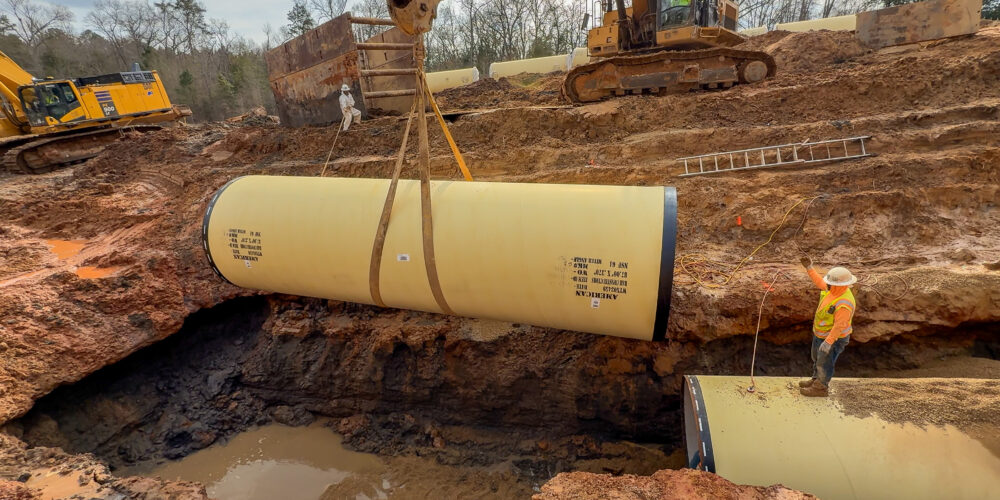
The 150-mile joint Integrated Pipeline (IPL) project designed to move water from three East Texas reservoirs into the Metroplex has reached a milestone at two-thirds of the way complete.
100 miles is a very big deal, when you consider the years of design, planning, manufacturing, installation in sections along the way, and the testing that has occurred -piece by piece – to reach this point.
The IPL has been in development since 2009, in response to North Texas growth projections and the need for more water that will come as the population continues to increase. Dallas-Fort Worth has been cited as one of the fastest growing metro areas in the U.S., and the forward-thinking Integrated Pipeline project, when fully operational by 2037, will have the capacity to transport 350 million gallons of water per day – ensuring local communities’ access to reliable water supplies for decades to come.
“Partnership is a key word when we talk about this project,” said TRWD engineer Shelly Hattan.
Shelly assists in leading the project with IPL Program Manager Ed Weaver, who has been with TRWD for more than 50 years. Ed has worked in a variety of roles for the Water District during his tenure, but none as large as this.
At one point, there were 11 design firms consulting on engineering services, land acquisition and permits. And over time, hundreds of in-house and outside team members from around the world have been involved in this project that will benefit hundreds of thousands of local residents when it wraps up by the target year 2037. The work of different teams ranges from survey, design and drafting to engineering, drilling, manufacturing, major regional support services and more. The construction portion of the project started in 2013 and has been ongoing since then.
“There are also teams within teams,” Shelly said.
Working together
The partnership with Dallas has not only been of positive economic impact to the area, but also demonstrates what can be done when two utilities join together on regional planning.
“What’s driving us is the goal of staying ahead of future North Texas growth,” Ed said.
The Integrated Pipeline will benefit all of DWU and TRWD’s customers, including their largest demand centers which are primarily located in Dallas, Tarrant and Denton Counties. These counties are part of the Region C Water Planning Area, which also includes the counties of Collin, Cooke, Ellis, Fannon, Freestone, Grayson, Henderson, Jack, Kaufman, Navarro, Parker, Rockwall and Wise.
As of 2016, the population of Region C was estimated to be slightly higher than seven million, all served by reservoirs and other water sources in these areas. Projections from the 2022 Texas State Water Plan predicted the population to double and the water demand to increase by about 70% by the year 2070. While TRWD has worked with Dallas Water Utilities and the North Texas Municipal Water District for years on water conservation, there was never before a plan bringing two water agencies together, looking 50 years forward, like the Integrated Pipeline.
“Our studies showed that one pipeline instead of two separate systems in the same vicinity would save rate payers money and would be more efficient,” Ed said. “By coming together to meet the demands of our region, we were able to outline a savings of $900 million for North Central Texas.”
Building benchmarks
This innovative project is setting standards for the industry in other ways as well. With different design, manufacturing and installation teams working on the pipeline, storage reservoirs and pump stations, there was a need for consistency from the beginning. Getting and keeping everyone “on the same page” meant standard specifications and rigorous testing at different steps along the way.
“Team members have traveled around the world to visit manufacturing facilities and test full assembly right at the factory where the components are built. It’s in our best interest to resolve any issues early, making sure the parts all fit as intended, so when they arrive, they are ready to go,” Ed said. “The factories can address any concerns while we’re there, so we don’t have to send parts back later. It pays off at installation time.”
It’s not just the engineers who travel when trips to different factories are needed – the pump mechanics and electricians who work directly on the pipelines and pump stations take part as well.
“The manufacturers really appreciate that,” Shelly said. “They’ve actually incorporated some of our staff’s suggestions into their future designs and processes.”
Influencing the industry
TRWD is leading the way in other innovative ideas as well. Using the latest research and American Waterworks standards to closely collaborate with design and manufacturing firms, the Integrated Pipeline project has introduced new discoveries in production that are influencing the entire industry. As an example, the research found lighter colored and thicker exterior coating of the steel pipelines keep surface temperatures of pipes awaiting installation lower than the traditional dark blue exterior color, resulting in protection against UV exposure and extended expected coating life (up to 100 years).
“We’ve based a lot of our decisions on life cycle costs – what it will take to maintain the project – rather than on initial capital costs alone,” Shelly said.
Another “first” resulting from this project was construction of large balancing reservoirs rather than smaller steel tanks, allowing operators to change pump speeds based on real-time energy costs. The reservoirs are filled at night when water demands and energy rates are lower.
A solution was also designed to protect against zebra mussels, a small, invasive freshwater species that clogs water pipes and promotes harmful sediment. TRWD found a company in England that could build gate valves large enough for Pipeline Intervention Gadgets (PIGs) to pass through as they clean. This was a first for Texas. These pipeline devices, interestingly shaped like a pig’s body, help maintain the pipes by keeping unwanted species and debris from sticking around.
The key to all these innovations has been teamwork.
The power of many
With a number of different contractors in the area working on the project, there was even opportunity for a new pipe manufacturing plant to open in Paris, Texas, adding economic growth to the growing list of the IPL’s attributes.
“The consultant groups on this project have served as an extension of our staff throughout. We work so much as a team. It’s critical. We really have the right people working together,” Shelly said.
From the onset, Ed noted, different outside teams were brought in-house as needed.
“Once a month, the design teams came to meet. Sometimes we met at their facilities. For others, we made space in TRWD offices, and some designers actually moved here,” he said.
The program allows TRWD to ramp up as needed, so consultants are often coming and going. It’s both manageable and cost effective.
“The 150-mile pipeline is being installed through several different geologic formations of rock, clay, even sand in some areas. Each presents a different design challenge,” Shelly said. “No single firm had the resources to manage the design and construction as a whole, so pieces of the project were divided into 15-mile segments, with different configurations for the requirements of each pump station.”
A win-win for all
Conceptual studies performed early on allowed the team to break the project into pieces to help manage costs.
“We call this just-in-time delivery,” Shelly said.
“This has benefitted the contractors as well. Rather than waiting for full payment at the end, they have been paid for their work along the way as certain milestones have been achieved,” Ed said.
At this point, Phases 1 and 2 have been completed and are in operation, including pipelines and pump stations from Cedar Creek Reservoir to TRWD’s Kennedale Balancing Reservoir. Phase 3 is currently under construction and includes a new pump station on Lake Palestine and 45 miles of 84” pipe to connect to TRWD’s raw water transmission system. Phase 4 includes a new pump station on the Richland-Chambers Reservoir.
The IPL is a source of pride for TRWD, Dallas Water Utilities and the entire region.
In reflecting back on his long history with TRWD, Ed recalls driving his young daughter, who is now grown, around some of the Water District’s major construction achievements many years ago and telling her proudly, “Your dad built that.”
Now, all these years later, thanks to a major feat for North Central Texas involving experts from around the world and right at home in the Lone Star State, he can point to each Integrated Pipeline joint accomplishment along the way and say, “Isn’t this something? WE built that.”