Lake Levels - West Fork Reservoirs
Lake Levels Questions and Answers
As a water provider and manager/operator of four major reservoirs, we often get questions about lake levels and water releases. Many of the questions and concerns focus on our West Fork reservoirs – Eagle Mountain Lake and Lake Bridgeport. Some of the questions we receive are based on rumors and misinformation. That’s not good. So, to keep you in the know, Tarrant Regional Water District is providing you with reliable and accurate information to answer your questions and help clear the water.
Background: How are Lake Bridgeport, Eagle Mountain Lake, and Lake Worth tied together?
Lake Bridgeport, Eagle Mountain Lake, and Lake Worth were all created by dams built on the same river system – the West Fork of the Trinity River. The primary purposes for each of these reservoirs are water supply and flood control.
The way these lakes line up, releases from Lake Bridgeport flow downstream into Eagle Mountain Lake. Releases from Eagle Mountain flow downstream into Lake Worth. And water flowing out of Lake Worth flows into the West Fork of the Trinity River, which passes just north of downtown Fort Worth before continuing east to Dallas.
Lake Bridgeport and Eagle Mountain Lake have spillway gates that allow for controlled releases from each reservoir before lake levels reach conservation pool elevation. The only way for water to leave Lake Worth, on the other hand, is for the lake to fill up to its conservation elevation, at which point it begins flowing over the spillway.
Tarrant Regional Water District operates these reservoirs as a system. In cases of heavy rainfall, we can use Lake Bridgeport and Eagle Mountain Lake to temporarily hold back water to reduce flooding downstream. On the water supply side, we can release water from Lake Bridgeport and Eagle Mountain Lake to meet demands of municipal water treatment plants that tap into Eagle Mountain and Lake Worth.
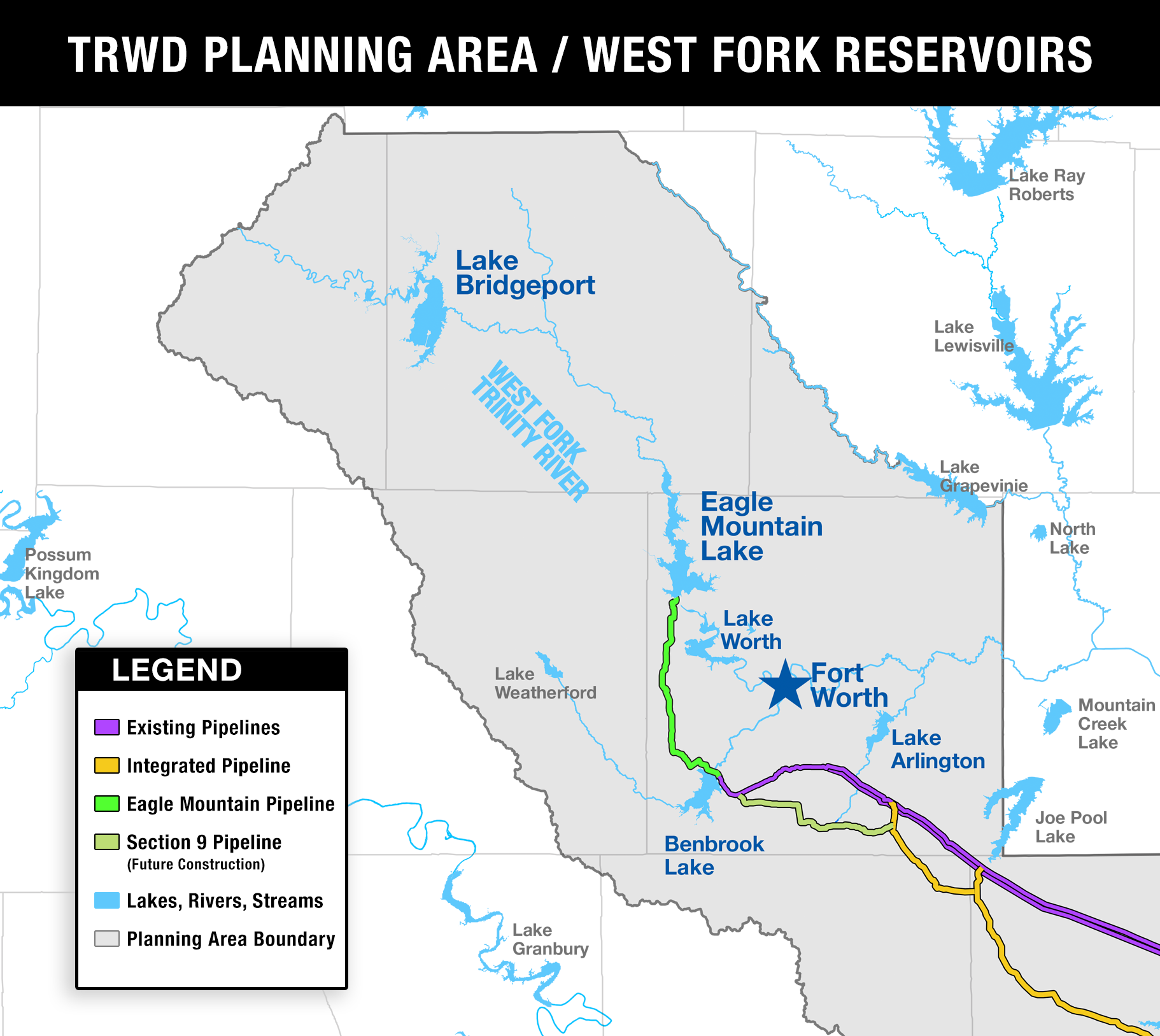
Below: Map of Lake Bridgeport, Eagle Mountain Lake, Lake Worth and the West Fork of the Trinity River in relation to Fort Worth.
Comment: We were told by our realtor that Eagle Mountain Lake was a constant level lake.
There are no constant level lakes in North Texas. In fact, all lakes in Texas rely on rainfall and runoff to get replenished. Water levels will continuously fluctuate depending on demands and weather conditions.
Think of a reservoir as a savings account for water supply. Its main purpose is to capture rainwater and store it for future use. During periods of heavy rainfall and low water use, lake levels tend to climb. During times of high demand, high evaporation and low rainfall, lake levels will fall. This is typically more noticeable in the hot, dry summer months.
If you’ve lived in Texas for a few years, you know that when rainfall is in short supply, we can experience extended periods of drought. When that happens, lake levels are sure to drop until the rainfall returns. The only thing that is constant about lake levels in Texas is that they will change over time.
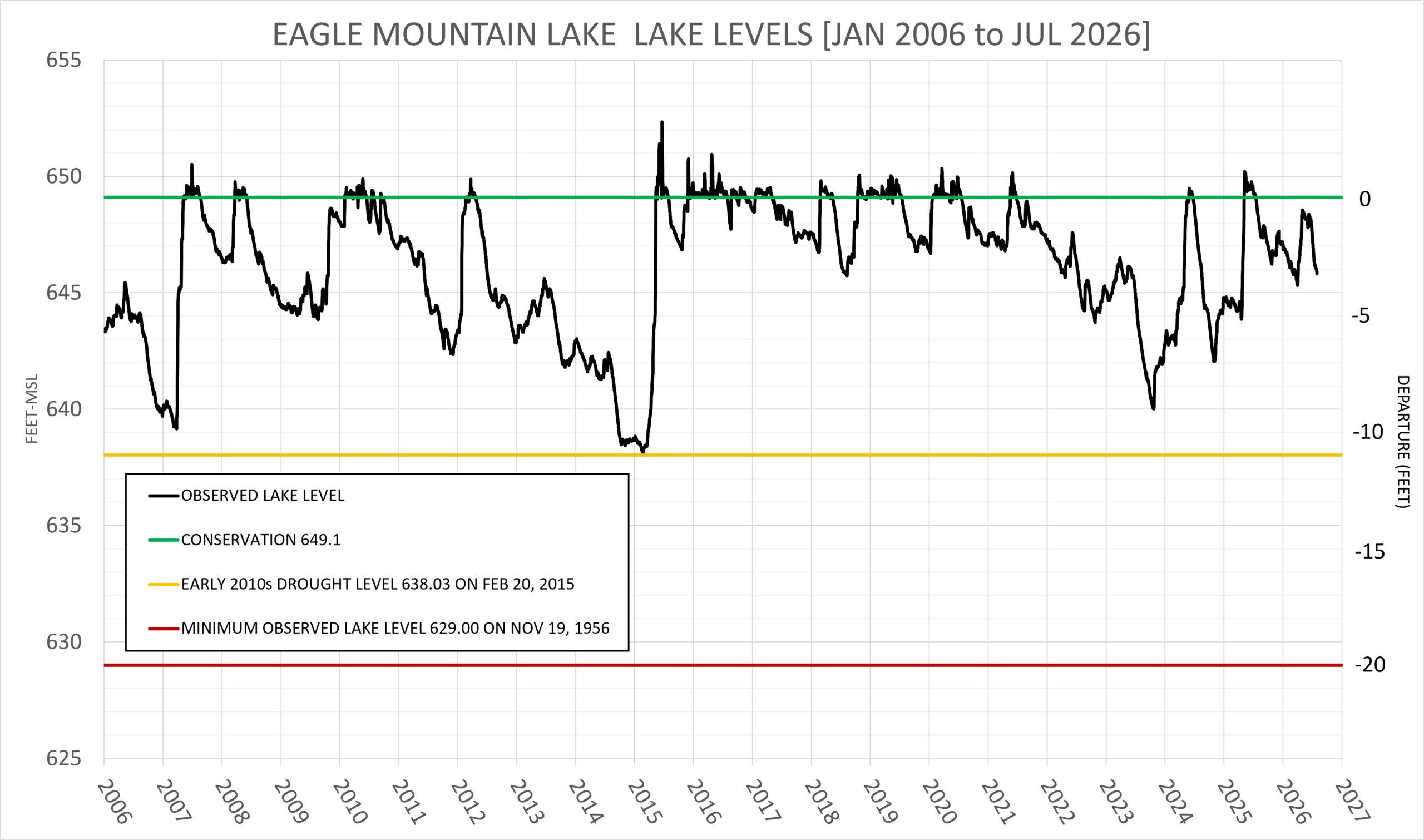
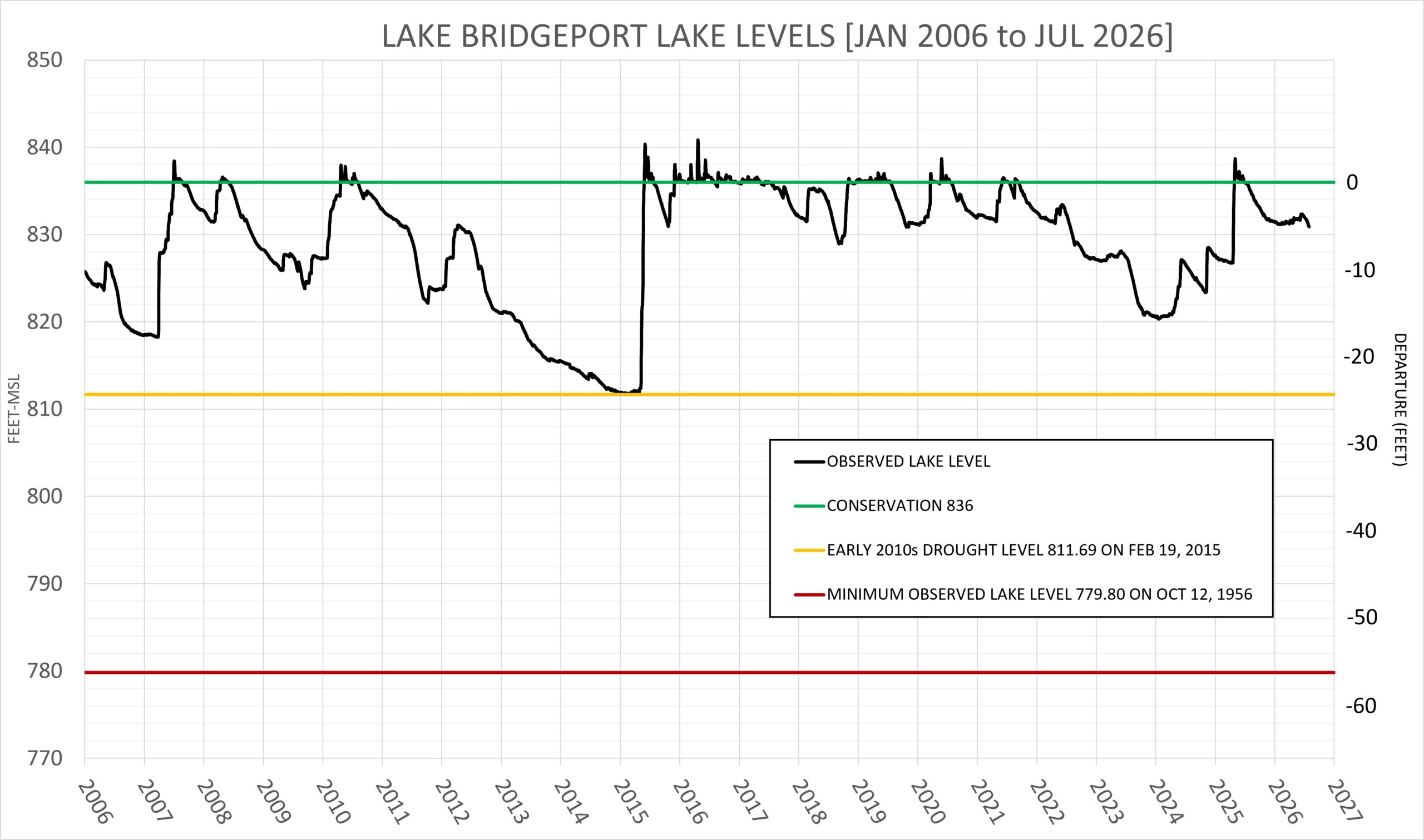
To give you a better idea of how lake levels fluctuate over time, here’s a historical look at lake levels for Eagle Mountain Lake and Lake Bridgeport since 2006.
Does evaporation really influence lake levels that much?
Yes. Evaporation has a major influence on lake levels. In fact, over the course of five years of observations (2021-2025), evaporation accounted for almost a quarter (23%) of the outflows from Eagle Mountain Lake. During the hottest days of summer, evaporation can account for 30 percent or more of the daily decreases in West Fork lake levels.
On a breezy, hot summer day, lake levels can drop as much as 0.5 inches/day, or more than three inches per week. It adds up. So, over the course of a week, we could lose hundreds of millions of gallons from our reservoirs due to evaporation before it ever gets used.
You can keep up with all the factors affecting lake levels, including evaporation, on the daily report published weekdays by our Water Resources Engineering Department on trwd.com.
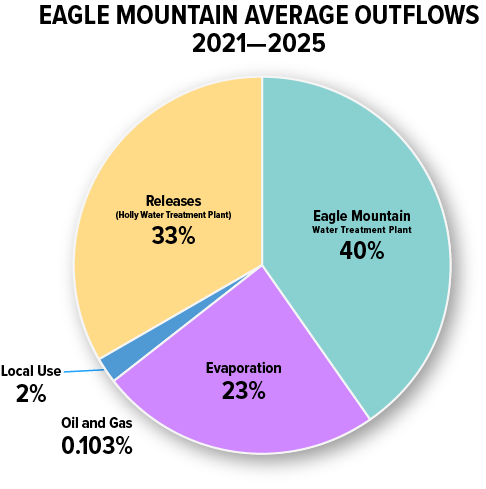
The pie chart below provides a breakdown of outflows from Eagle Mountain Lake driven by water demands and evaporation (2021-2025):
- 40% of the outflows were due to water demands driven by the Eagle Mountain Water Treatment Plant operated by the Fort Worth Water Department.
- 33% of the outflows were released into Lake Worth to supply the Holly Water Treatment Plant operated by the Fort Worth Water Department.
- 23% of the outflows were attributable to evaporation.
- About 2% went to local water users, such as Springtown and Azle, that divert water out of the lake.
- Water needed for oil and gas production amounted to about 0.10% of total water outflows from Eagle Mountain Lake.
How does the Eagle Mountain Pipeline help lake levels in Eagle Mountain and Lake Bridgeport?
TRWD built the Eagle Mountain Pipeline in 2008 to supplement storage in the West Fork system, which is more prone to drought conditions than our reservoirs in East Texas.
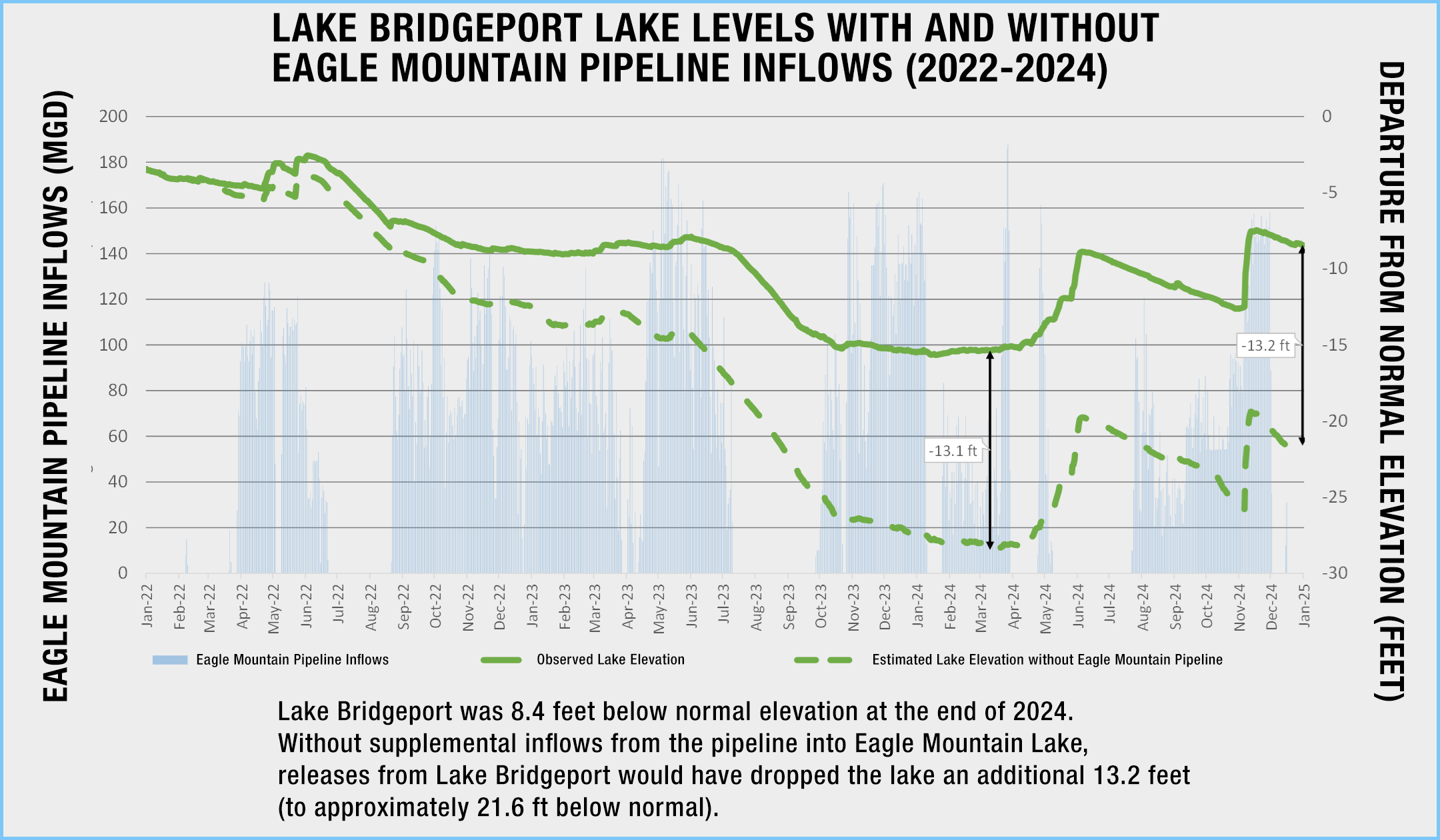
The $170 million, 20-mile pipeline allows the Water District to move water from its East Texas lakes directly into Eagle Mountain Lake. Adding more water to Eagle Mountain Lake through the pipeline reduces the amount of water we have to release from Lake Bridgeport to meet water demands. And that helps us keep more water in Lake Bridgeport.
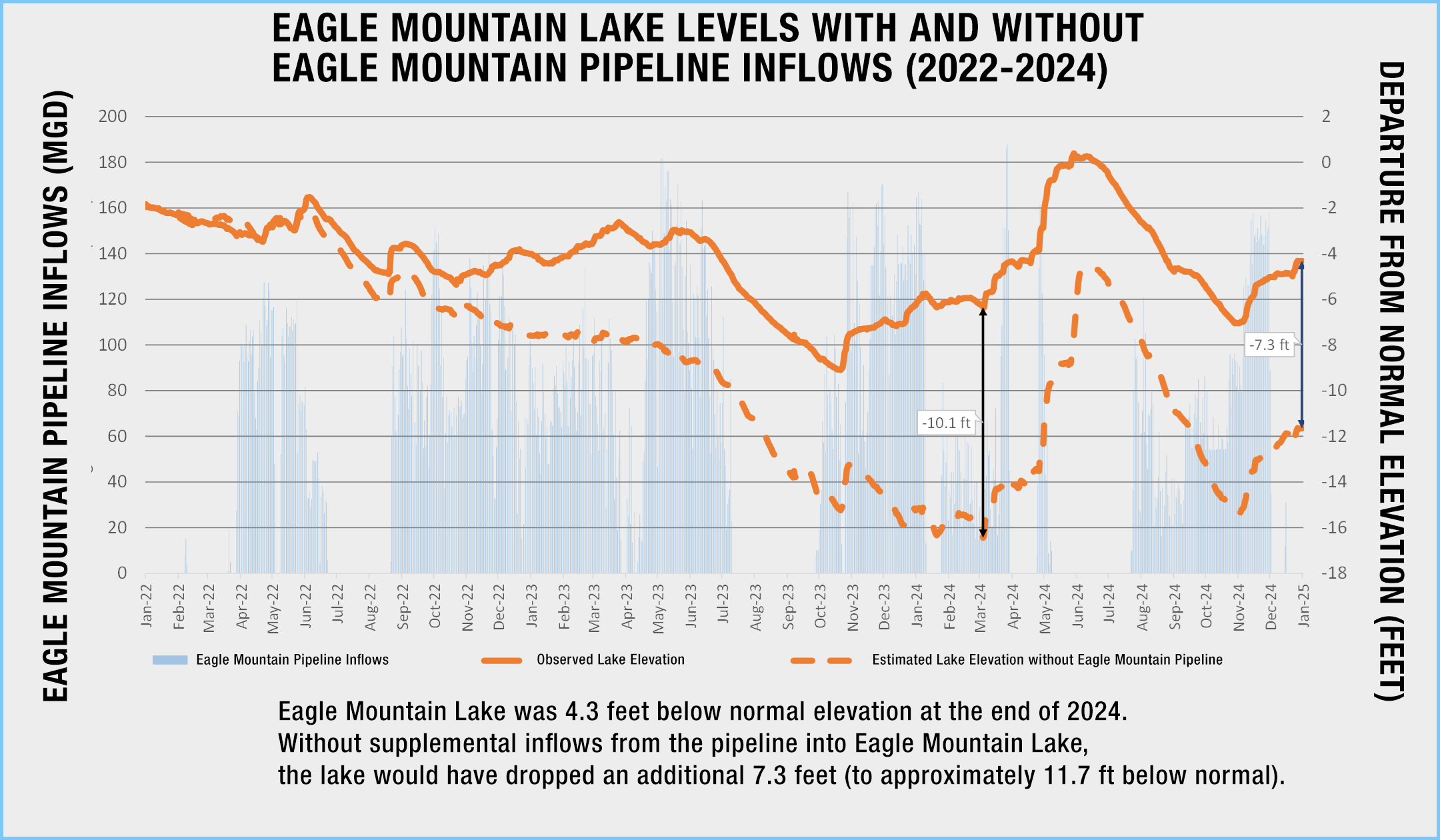
Over the course of three years, from 2022-2024, we moved more water through the pipeline into Eagle Mountain Lake than it received from rainfall and runoff. That’s pretty incredible.
The total volume of water pumped from East Texas into Eagle Mountain Lake (2022-2024) was 60 billion gallons. During that period, lake levels without the pipeline would have fallen twice as much as we observed.
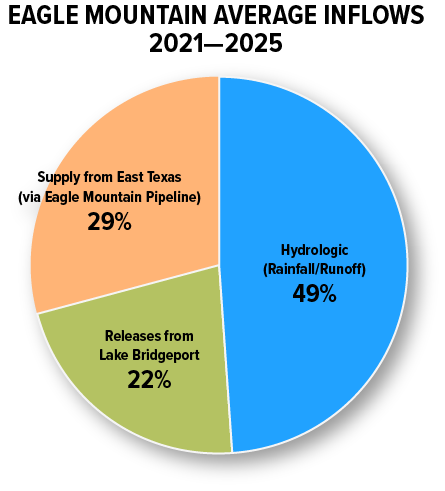
The pie chart below expands the time horizon to a 5-year period and depicts the average breakdown of inflows into Eagle Mountain Lake (2021-2025):
- Rainfall and runoff flowing into Eagle Mountain: 49%
- Volume of water added via pipeline: 29%
- Releases from Lake Bridgeport: 22%
Why is Lake Bridgeport always a lot lower than Eagle Mountain Lake?
That’s not always the case. But a lot of times Lake Bridgeport is indeed lower than Eagle Mountain Lake. Here’s why…
TRWD manages Lake Bridgeport and Eagle Mountain Lake as part of a connected reservoir system. Water is released from Bridgeport to Eagle Mountain when it’s needed to support demands, especially during droughts or summer months when our water use increases.
Lake Bridgeport holds about twice as much water as Eagle Mountain Lake when both lakes are full: 372,000 acre-feet compared to 185,000 acre-feet. Its deeper and more compact basin stores more water per foot of elevation, making it more efficient for long-term storage. So, even when lake levels in Bridgeport are down twice as much as Eagle Mountain, the reservoirs are still about the same percent full.
Eagle Mountain Lake is shallower, and its shape results in water supply intakes being positioned closer to the surface. These intake structures are more vulnerable to falling below operational levels during periods of drought.
To reduce the chances of service interruptions at Eagle Mountain’s water treatment plants, TRWD works to maintain healthy lake levels there. At the same time, releases from Bridgeport are carefully managed to avoid drawing it down too far and impacting its own water intakes.
Operational guidelines are designed to balance these risks, supporting reliable water service across the system without putting one reservoir’s customers at a disadvantage.
Another factor that can play a role in lower lake levels at Lake Bridgeport is that it typically receives less rainfall than Eagle Mountain.
Why are you releasing water from Eagle Mountain Lake when it is already low?
The primary reason for releasing water from Eagle Mountain Lake (when it’s not flooding) is to support the intake for the Holly Water Treatment Plant on Lake Worth. Our goal is to keep lake levels in Lake Worth from dropping below the threshold where it would impact deliveries to the drinking water treatment plant.
In this case, the critical threshold at Lake Worth is four feet below the conservation pool. At that level, the water intake for the Holly Plant would cease to function at 100% capacity, limiting production at one of the City of Fort Worth’s water treatment plants.
We use operational guidelines based on the combined storage levels in Bridgeport and Eagle Mountain to determine how much water is released to maintain lake levels in Lake Worth. The lower the storage in the West Fork water supply reservoirs, the lower Lake Worth will be.
Why can’t you keep more water in Eagle Mountain Lake after it rises above conservation pool?
All the reservoirs in our West Fork system – Lake Bridgeport, Eagle Mountain Lake, and Lake Worth – were built at a time when zoning wasn’t much of a consideration. This resulted in homes that were built within a couple of feet of the conservation pool elevation at each of these lakes, which means there is not much leeway when it comes to rising lake levels.
The lowest house on Lake Bridgeport is 3.0 feet above conservation. At Eagle Mountain Lake, the lowest residence is 2.4 feet above conservation. And at Lake Worth, the first house begins to flood when the lake reaches 3.4 feet above conservation.
Retaining water above the conservation pool in any of these reservoirs longer than necessary reduces their capacity to hold additional floodwater that could be produced by more rainfall.
As you know, weather can be tricky to predict. Releasing the water above conservation pool reduces the chance of flooding if additional rain comes along. For low-lying residences around the lakes, an extra foot of holding capacity can make all the difference between staying dry and getting flooded.
Is there a way to see how much water is being pumped / released from Lake Bridgeport and Eagle Mountain Lake?
Yes. We release a daily report for all our reservoirs on weekdays. The report details changes in lake elevations, volume of water pumped from each lake, volume of water pumped into each lake, water supply releases, flood discharges, evaporation volumes, and precipitation amounts, among other information.
You can find the daily report on our website at: https://www.trwd.com/resources/water-supply/
Why does it seem like the West Fork Reservoirs are almost always less full than your East Texas Reservoirs?
There are multiple reasons that the West Fork Reservoirs are usually less full than our East Texas Reservoirs (Cedar Creek Lake and Richland-Chambers Reservoir).
The first reason has to do with climate. When people say, “Fort Worth is where the west begins,” what they’re really saying is the further west you go, the drier it gets. And that’s so true.
The average annual rainfall at our East Texas Reservoirs ranges between 40-50 inches. As you head west, the range drops off. Average annual rainfall for the western portions of North Texas is between 30-40 inches. Less rainfall and runoff mean the rates at which the West Fork Reservoirs are replenished are lower than that of the East Texas Reservoirs.
You can find monthly and annual precipitation data measured at DFW Airport by the National Weather Service here.
A second reason that the lake levels of our East Texas Reservoirs are usually higher is their size – both watershed size and reservoir size.
The area draining into our East Texas Reservoirs is 1.5 times larger than the area draining into our West Fork Reservoirs. More rainfall over a larger watershed means more runoff, nearly double compared to the West Fork system.
As for reservoir size, Richland-Chambers can store 1,100,000 acre-feet and Cedar Creek Lake has a storage capacity of 645,000 acre-feet. Compare that to Lake Bridgeport and Eagle Mountain, which have storage capacities of 372,000 acre-feet and 185,000 acre-feet, respectively.
We can pull a lot more water from the East Texas Reservoirs without impacting lake levels as dramatically as pulling water out of the West Fork Reservoirs. And that’s why about 80 percent or more of the water we consume in Tarrant County comes from East Texas.
How much of an impact does the oil and gas industry have on West Fork water supplies?
TRWD water sales to the oil and gas industry reached their peak in the 2008-2011 timeframe. At that time, about two percent or less of our total annual water sales were consumed by the oil and gas industry for drilling and fracking wells.
During those peak years, we did supply approximately 1.5 to 2.5 billion gallons of water to oil and gas operations annually. But since the peak, drilling demands have subsided considerably – from billions of gallons to less than 200 million gallons annually district-wide, or less than one percent of TRWD’s total annual water sales.
In the West Fork, the average amount of water used for oil and gas operations amounts to approximately one-tenth of one percent of West Fork water supplies.
Additional sources of information
- Daily Report: https://www.trwd.com/resources/water-supply/
- Lake Level Blog: https://www.trwd.com/category/lake-level-blog/
- Lake Levels: https://trwd.onerain.com/
- WaterDataForTexas: https://www.waterdatafortexas.org/reservoirs/statewide
Water Quality
What is the quality of our reservoirs?
Since the late 1980s, TRWD has been collecting water quality data from each reservoir, the major tributaries to each reservoir and some wastewater plants near the reservoir. Samples are typically taken quarterly, and the data is used to monitor the health of the water on a short-term and long-term scale. The reservoirs were built for water supply, and for that purpose, the water quality is in great shape. This chart shows the parameters that are monitored. Read the most recent water quality executive summary.
Is the water safe to swim in?
There is an inherent danger when swimming in a natural lake because of naturally occurring bacteria. TRWD routinely samples the reservoirs and Trinity River for E. coli bacteria. This data is used to assess the waters based on the standards set by the Texas Commission on Environmental Quality and approved by the US EPA. Our reservoirs have shown great compliance under the standard for contact recreation, but we know at times of flooding when the water is turbid from runoff, the potential for elevated bacteria is a concern. The Trinity River is much more susceptible to a change in water quality from a small rain than reservoirs. Users should exercise caution on the river after a local rain.
What causes tastes and/or odor changes in my drinking water?
TRWD does not treat water for drinking. The district delivers raw water to its customers’ water treatment plants and storage lakes in Tarrant County where the cities then treat the water and supply more than 2 million residents. Geosmin, an organic compound commonly found in Texas lakes during the winter months, causes the taste and odor changes. Geosmin is not harmful to your health but does have a distinct earthy flavor and aroma. Customer cities are aware of the change and treat for geosmin; however, there are times when they cannot fully remove it. The district also performs regular water quality monitoring and posts these reports monthly.
Are the fish safe to eat from the lakes and Trinity River?
There are no fish consumption advisories for any of the TRWD reservoirs. Lake Worth, which is managed by the City of Fort Worth, has an advisory posted for channel and blue catfish and smallmouth buffalo that extends up to the segment of the Trinity River between Lake Worth and Eagle Mountain Lake (ADV-45). The Clear Fork of the Trinity River below Lake Benbrook and West Fork of the Trinity below Lake Worth continuing downstream south of Dallas do have advisories posted warning of no consumption of any species of fish (ADV-43). Please visit the Texas Department of State Health Services for maps and the latest posting of fish consumption advisories.
What is PAM, the amoeba that can kill young swimmers?
Primary amoebic meningoencephalitis (PAM) is a rare and usually deadly disease caused by an amoeba, Naegleria fowleri. This microscopic animal is found worldwide and is rather common, but the infection is rare. The infection occurs when the amoeba enters the body through the nose. This occurs when an individual is swimming or diving. The amoeba then travels to the brain and destroys the organ. Although the risk of contracting this disease is rare, some prevention is worth practicing when swimming in any natural body of water, including TRWD lakes and the Trinity River.
- Avoid swimming in coves that are isolated from the main body of the reservoir
- Avoid swimming when the water is really warm
- Hold your nose or wear nose plugs when diving or jumping into the water
- Avoid digging or stirring up sediment when swimming in shallow water areas
TRWD tests all the reservoirs and the river regularly for a bacteria, E. coli, that is an indicator of polluted water. While this test is not for Naegleria fowleri specifically, TRWD does not feel contact recreation is a significant problem. To whatever small degree, the risk of infection does exist and individuals wishing to use the reservoirs or the river should consider all risks involved. Click here to learn more from the CDC.
Water Supply / Lake Levels
Where does Tarrant County's water come from?
During a typical year, 80 to 85 percent of the water TRWD provides to its primary wholesale customers comes from Cedar Creek and Richland-Chambers lakes. The other 15 to 20 percent comes from Lake Bridgeport, Eagle Mountain Lake and Benbrook Lake. (Benbrook Lake is managed by the U.S. Army Corps of Engineers).
What does conservation level mean?
The amount of water an entity can impound at a reservoir under its Water Rights Permit. Once a reservoir fills its conservation pool, any water above that level must be discharged unless the water is being temporarily stored for routing flood waters.
Conservation Levels for TRWD Lakes:- Richland-Chambers 315.0
- Bridgeport 836.0
- Eagle Mountain 649.1
- Cedar Creek 322.0
- Arlington 550.0
- Benbrook 694.0
- Lake Worth 594.0
Does TRWD post information about water levels and pumping changes?
Yes. TRWD posts this information daily. TRWD’s Daily Report is updated every 24 hours and lists the following data for TRWD lakes as well as Benbrook Lake, Lake Arlington and Lake Worth: Conservation Level, Lake Level, Change in Lake Level, Pumpage from Lake, Pumpage into Lake, Flood Discharge, Water Release and Evaporation.
But we have a reliable water supply, why should I protect/conserve water?
Water supplies are strained by growing populations and increasing demand. Each year, Texans spend more than $1 billion dollars on new or expanded water supply and wastewater treatment facilities. Water conservation not only saves money on your monthly water bill, it also minimizes future water shortages and costs. The district manages two water conservation campaigns: Save Tarrant Water and Water is Awesome.
Open Records Request
According to Section 49.452 of the Texas Water Code, TRWD is not required to provide a Notice to Purchaser for real estate transactions within its boundaries. The District does not provide services to household or commercial users, and does not currently have any outstanding general obligation debt to provide those services.
How to Request Open Records
To request open records from the Tarrant Regional Water District (TRWD), visit our Open Records Request portal or submit by mail or fax. Provide a detailed description of the records requested and include the name, address, and a daytime telephone number of the person making the request. Requests submitted after 5 p.m. Monday through Thursday will be considered as received on the next business day. Requests submitted after 4:30 p.m. on Friday will be considered as received on the next business day. The District no longer accepts PIA requests via fax.
By Mail: TRWD, Attn: Open Records Request800 E. Northside Drive Fort Worth, Texas 76102
What you need to know about Open Records Requests
Information taken from the Office of the Attorney General website
Your request must be in writing. Only written requests trigger a governmental body’s obligation under the Public Information Act.
Your request should be for records that are already in existence. Governmental bodies are not required to answer questions, perform legal research, or comply with a continuing request to supply information on a periodic basis as such information is prepared in the future.
The Public Information Act allows governmental bodies to set a charge for providing copies of public records.
What Requestors can expect
The governmental body must “promptly” produce public records in response to your request. “Promptly” means that a governmental body may take a reasonable amount of time to produce the records, which varies depending on the facts in each case. The amount of records you have requested is highly relevant to what makes a reasonable response time. Please note that TRWD is required to give a response to written requests for records within ten business days. This response may range from providing the requested records, seeking clarification of the request, certifying to a date that the records could be produced or seeking an Attorney General opinion. If clarification is sought, please note that a request for information is considered withdrawn if the requestor does not respond in writing to the District’s written request for clarification or additional information within 61 days.
The Public Information Act prohibits the governmental body from asking why you want the records you have requested. The governmental body may, however, ask you to clarify the request if it is uncertain as to what you want, and it may discuss with you how the scope of your request may be narrowed if you have requested a large amount of information.
If the governmental body wishes to withhold any of the information requested, it must:
Seek an attorney general decision within ten business days of its receipt of the request and state the exceptions to disclosure that it believes are applicable. The governmental body must also send you a copy of its letter to the attorney general requesting a decision within ten business days. If the governmental body does not notify you of its request for an attorney general decision, the records you requested are generally presumed to be open to the public.
Within 15 business days of receiving your request, the governmental body must send the attorney general its arguments for withholding the requested information and copies of the records that were requested. You are entitled to receive this notice; however, if the letter to the attorney general contains the substance of the information requested, you may receive a redacted copy of the letter. If the governmental body does not timely request an attorney general decision, notify you that it is seeking an attorney general decision, and submit to the attorney general the records you requested the record is generally presumed to be open to the public.
If an attorney general decision has been requested, you may submit your written comments to the attorney general stating any facts you want the Open Records Division to consider.
Notice to Purchaser Information
TRWD is not subject to the Notice to Purchaser requirements of Section 49.452 of the Texas Water Code for real estate transactions within its boundaries. The District does not provide services to household or commercial users and does not currently have any outstanding general obligation debt to provide those types of services.
TRWD’s tax rate is $0.0273 on each $100 of assessed valuation. The total amount of bonds, excluding refunding bonds and any bonds or any portion of bonds issued that are payable solely from revenues received or expected to be received under a contract with a governmental entity, approved by the voters and which have been or may, at this date, be issued is $250,000,000, and the aggregate initial principal amounts of all bonds issued for one or more of the specified facilities of TRWD and payable in whole or in part from property taxes is $98,710,000.
TRWD has not adopted or imposed a standby fee on property in its jurisdiction.
PLEASE BE ADVISED THAT THE INFORMATION SHOWN ABOVE IS SUBJECT TO CHANGE BY TRWD AT ANY TIME.
Texas Landowner's Bill of Rights
Texas Landowner’s Bill of Rights
Data Center Water Request
Last Updated 7/27/2026
Tarrant Regional Water District (TRWD) is a regional water authority responsible for raw water supply and reservoir operations across an 11-county service area in North Texas, including Cedar Creek, Richland-Chambers, Lake Bridgeport, and Eagle Mountain Lake. As interest in data center development grows across our region, TRWD is committed to providing clear, accurate information about our role in evaluating water supply requests.
TRWD does not treat water for distribution, and we do not have authority over zoning, electricity, air or noise regulations, or local development approvals. Those decisions rest with the cities, counties, and state agencies that govern those areas.
This page answers common questions about how TRWD evaluates water requests from prospective customers, including data centers.
City of Fort Worth Data Center Resources
The City of Fort Worth has published its own data center information page, covering the City's role in zoning, noise, water utility requirements, and economic development incentives for data center projects. Residents with questions on those topics may go to the City of Forth Worth's website.
On June 10, 2026, Governor Greg Abbott directed the Public Utility Commission of Texas (PUCT) and the Electric Reliability Council of Texas (ERCOT) to take action protecting Texas ratepayers and communities from the costs and impacts of data center growth. Read the Governor's latest update on these actions: Governor Abbott Announces PUC and ERCOT Actions Protecting Residential Ratepayers From Data Center Costs
GOVERNANCE & AUTHORITY
How does TRWD handle requests for water from data centers?
All requests for raw water supplied directly by TRWD, including those related to data centers, are evaluated by TRWD staff following a consistent review process. Requests must be submitted to TRWD in writing using the Raw Water Request Document, and all required information must be provided prior to TRWD beginning a formal evaluation of the request.
TRWD evaluates requests to determine whether TRWD can serve the request while still maintaining water supply reliability for all existing customers, taking into account many considerations, including the basis for the volume requested, system impacts, conservation efforts, and water quality considerations. Data centers must also comply with all state and local permitting requirements.
Has TRWD been approached by any data center companies?
Yes, TRWD has received requests from data center developers, including completed Raw Water Request Documents. In the case of the proposed Cedar Creek-area project, the developer and West Cedar Creek MUD have formally withdrawn their requests to obtain water from TRWD, and the project is no longer proceeding.
What is TRWD's status with any data center projects?
TRWD supplies water to several existing customers (such as the cities of Fort Worth, Mansfield, etc.) that use TRWD water for various purposes, including data center operations. However, TRWD has not entered into any new water supply contracts specifically to serve data center projects, nor has TRWD increased contract volumes for existing customers based on requests specifically made to serve data centers.
If a data center request meets TRWD's evaluation criteria, demonstrating adequate justification for volume, conservation efforts, and alignment with regional water planning, TRWD may consider contract negotiations.
Has TRWD signed any NDAs (Non-Disclosure Agreements) with data center companies?
No. TRWD has not signed any NDAs with any data center company. Our process is transparent and governed by public records laws.
Who ultimately decides whether TRWD will supply water to a data center?
The TRWD Board of Directors makes the final decision on all new raw water supply contracts. Decisions are made at monthly open Board meetings that are broadcast to the public and where the public can attend. Any contract approval will be a matter of public record.
How will residents know if TRWD approves a water permit for a data center?
TRWD does not issue any permits for water use – we enter into contracts to supply water. If a data center request meets TRWD's evaluation criteria and advances to the contract stage, the contract will be presented to the TRWD Board of Directors at the monthly, open, public Board meeting. The monthly meetings are broadcast and open for public attendance to ensure complete transparency in the decision-making process. All meetings are recorded and archived on our website for viewing anytime: View TRWD Board Meetings
WATER DEMAND & REGIONAL CAPACITY
How much water would a data center use?
Data center water consumption is highly variable and depends on the specific cooling technologies used and operational design. TRWD cannot provide a general answer about how much water a data center would use.
Before TRWD can evaluate any water request, the applicant must provide detailed justification for the volume requested and demonstrate how they plan to conserve and use water as efficiently as possible. To date, the applicant has not provided sufficient justification for the volume being requested, and we cannot proceed with formal evaluation until these critical details are submitted.
Where would the water come from?
TRWD supplies water through a large-scale transmission system comprised of seven lakes, multiple pump stations, and hundreds of miles of large-diameter pipelines serving an 11-county service area. These include Cedar Creek Reservoir, Richland-Chambers Reservoir, and other sources. The specific source for any water request would be determined during TRWD's technical evaluation process based on system needs, operational constraints, and regional water planning.
Is Cedar Creek Reservoir already under strain? Can it support additional demand?
TRWD has been approached regarding supply from Cedar Creek Reservoir for a proposed data center project. TRWD has not approved this request. Before TRWD can evaluate whether additional volume can be served, the following information is required:
- Adequate justification for the volume they are requesting
- A demonstration of how they plan to conserve water and use it as efficiently as possible
TRWD maintains rigorous regional water planning and forecasting to ensure a reliable water supply for all customers. Part of TRWD's evaluation process for any new water request is assessing whether the requested volume can be served while maintaining reliability for existing customers. If TRWD determines that a request cannot be met without compromising reliability to existing customers, the request will be denied.
What does TRWD's regional water planning say about capacity for large industrial users?
TRWD actively plans for water supply to serve our service area and will not enter into new contracts if they do not align with TRWD's long-range planning efforts. TRWD evaluates all requests on a case-by-case basis to determine if the requested volume can be reliably served.
CONSERVATION
If TRWD asks residents to conserve water, why would it supply millions of gallons to a data center?
TRWD evaluates all requests for water, regardless of use type or the type of entity requesting water. Whether the request is for municipal, agricultural, industrial, mining or data center use, TRWD applies the same rigorous evaluation criteria.
For any data center request, the applicant would have to demonstrate their efforts to conserve and use water as efficiently as possible. Data centers would be subject to rigorous conservation requirements, like other TRWD customers. This means a data center would need to demonstrate advanced water-efficient cooling technologies and operational practices before TRWD could consider approval.
TRWD's conservation messaging to residents applies universally: all customers, including large industrial users, are expected to use water efficiently.
What conservation standards apply to data centers?
All TRWD customers are required to have a Water Conservation Plan on file with TRWD and effectively implemented within their service area prior to execution of a new or amended raw water contract. All conservation plans must comply with TRWD's most current Water Conservation and Drought Contingency and Emergency Management Plan.
Data centers seeking water from TRWD would be required to meet these same standards, and potentially stricter ones depending on the facility design and operational requirements.
ENVIRONMENTAL IMPACT
What are the environmental impacts of data center cooling discharge?
Data centers typically use water for cooling purposes. The design and impacts vary significantly depending on the cooling technology used (evaporative cooling, closed-loop systems, etc.) and how discharge water is treated.
As part of TRWD's evaluation process, we assess water quality considerations and ensure any discharge impacts are addressed through appropriate treatment and permitting.
Would a data center impact Cedar Creek Reservoir's water quality?
Water quality protection is one of the criteria TRWD evaluates as part of its request review process. Any data center project would need to comply with all state and local permitting requirements, which include environmental protection standards. This typically involves Texas Parks and Wildlife Department (TPWD), Texas Commission on Environmental Quality (TCEQ), and local environmental reviews.
TRWD's evaluation includes assessment of water quality impacts and mitigation measures.
HOW TO STAY INFORMED
TRWD will provide updates through:- Our website FAQ (this page)
- Monthly board meetings
- Blog posts and e-newsletters
- Social media channels
- TRWD will host an Open Hall Meeting June 23 from 5:30 - 7:30 P.M. at the Mabank Pavilion at 200 S. Easley Parkway Mabank, TX
Last Updated 7/27/2026
Trinity Trails
For more information about the Trinity Trails, please visit the Trinity Trails website where you can view frequently asked questions about the Trinity Trails.
Eagle Mountain Park
What hours are Eagle Mountain Park open to the public?
The park is open to the public from dawn to dusk, seven days a week.
Is there a fee to use the park?
No, however, if you want to host an event of 100 or more people, a permit is required and a fee might be assessed. Smaller gatherings are allowed without a permit, but please keep the public in mind Eagle Mountain Park is a shared recreational resource that serves our entire community. During your event, no part of the park or trails can be closed off in any way to accommodate your guests. Eagle Mountain Park is a first-come, first-serve public amenity.
Are motorized vehicles allowed in the park?
Personal motorized vehicles are prohibited. This includes ATVs, golf carts, motorcycles, etc.
Is camping allowed?
Neither camping or campfires are allowed in Eagle Mountain Park. The public is expected to leave the park by dusk each day.
What facilities are available in the park?
Port-a-lets, water fountains, trashcans and covered picnic tables are conveniently located at the entrance to the park; however, the trails themselves do not offer these amenities. Please plan to provide your own water and remember whatever you pack-in, you must pack-out.
Are dogs allowed on the trails?
In order to protect the wildlife that thrive in our trail system, dogs are not allowed. Designated service animals are allowed.
Is horseback riding allowed?
The trails at Eagle Mountain Park are not designed to support horseback riding; therefore, it is not permitted.
Are bicycles allowed on the trails?
It is not permitted. The trails at Eagle Mountain Park are not designed to support cycling.
Is fishing available from Eagle Mountain Park?
Fishing is allowed in and along the shore of the lake with a Fishing License from Texas Parks & Wildlife. Please take into consideration it is approximately a mile hike to the shoreline.
Is kayaking available from Eagle Mountain Park?
Kayaking is allowed, but not easily accessible.
For other nearby TRWD kayaking opportunities, visit www.twinpointspark.com and www.trinitytrailsfw.com/paddling.
Twin Points Park
For more information about Twin Points Park, please visit the Twin Points Park website where you can find park rules and other frequently asked questions.
Bids / Vendors
I'm interested in becoming a TRWD vendor. Where do I start?
Please register your business at our Vendors page or directly at our vendor portal. After registration is complete you will be notified about opportunities with TRWD.
Where are your RFPs and bids posted?
Opportunities with TRWD can be found at our Vendors page and www.civcastusa.com.
Does TRWD have a diverse business policy?
Yes. You can view the entire policy here.
Where can I find contact information for your purchasing department?
Contact information is available at our Vendors page on the bottom of the page.